
Bridging AI Implementation Gaps: Transforming Data into Organizational Wisdom
In our conversations with business leaders who are looking for AI services, we’ve noticed there’s a growing pressure to implement AI, but organizations are lacking an understanding of where to start or what to build.
A guaranteed recipe for wasted resources and disappointed stakeholders would be slapping generative AI onto existing processes just to check a box for leadership. To mitigate the open ended nature of “implementing generative AI” we (at moonbird.ai) have developed a strategic methodology that focuses on creating business value and meeting companies where they’re at.
What’s fascinating is that our approach naturally evolved to complement a well-established framework in data science: the DIKW (Data, Information, Knowledge, Wisdom) pyramid. My first introduction to the framework was the below image from David Somerville which goes viral on social networks in the data circles every once in a while:
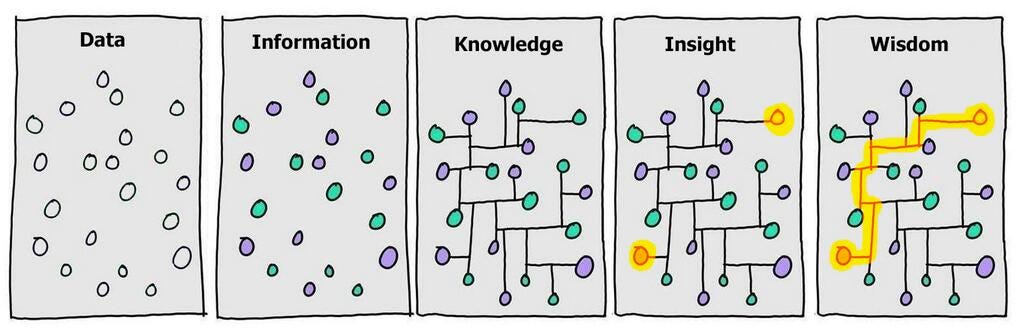
The DIKW Pyramid: A Foundation for Understanding
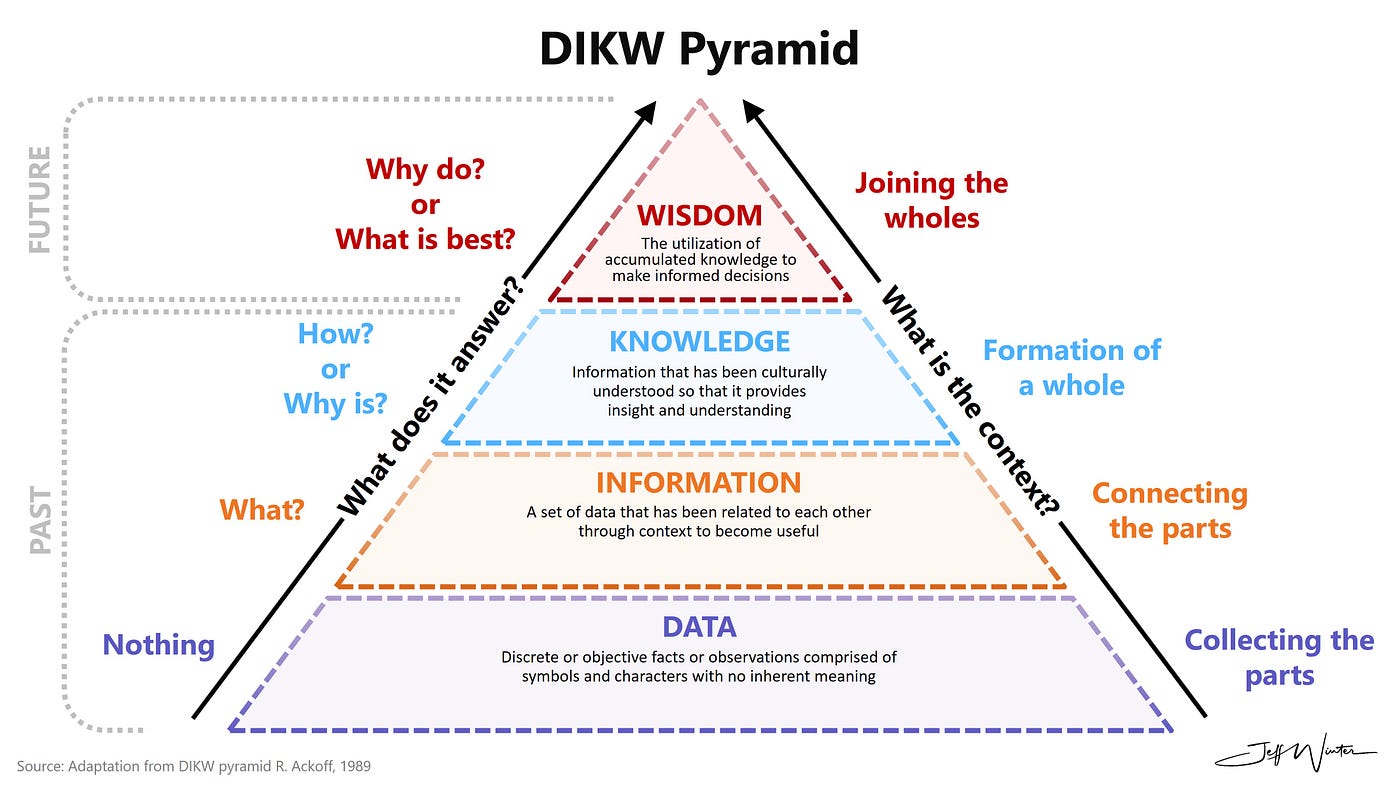
From some research, I’ve learned that the DIKW framework has been a cornerstone of knowledge management since Russell Ackoff popularized it in 1989. It represents how raw facts transform into actionable wisdom through progressive stages of context and understanding.
As the Ontotext team explains, “Each step up the pyramid answers questions about the initial data and adds value to it. The more questions we answer, the higher we move up the pyramid” (Ontotext, “What Is the Data, Information, Knowledge, Wisdom Pyramid?”).
What’s fascinating is that our framework doesn’t map directly to the DIKW layers themselves, but rather to the critical transitions between them. Each of our three implementation layers focuses on using technology to bridge a specific gap in the pyramid — helping organizations move from scattered data to structured information, from information to actionable knowledge, and from knowledge to practical wisdom.
We repeatedly see organizations who want to implement generative AI and jump straight from scattered data to automated wisdom, but you can’t build a bridge to the top floor without the supporting structure beneath it.
Our 3-Layer Framework: Bridging the Levels of DIKW
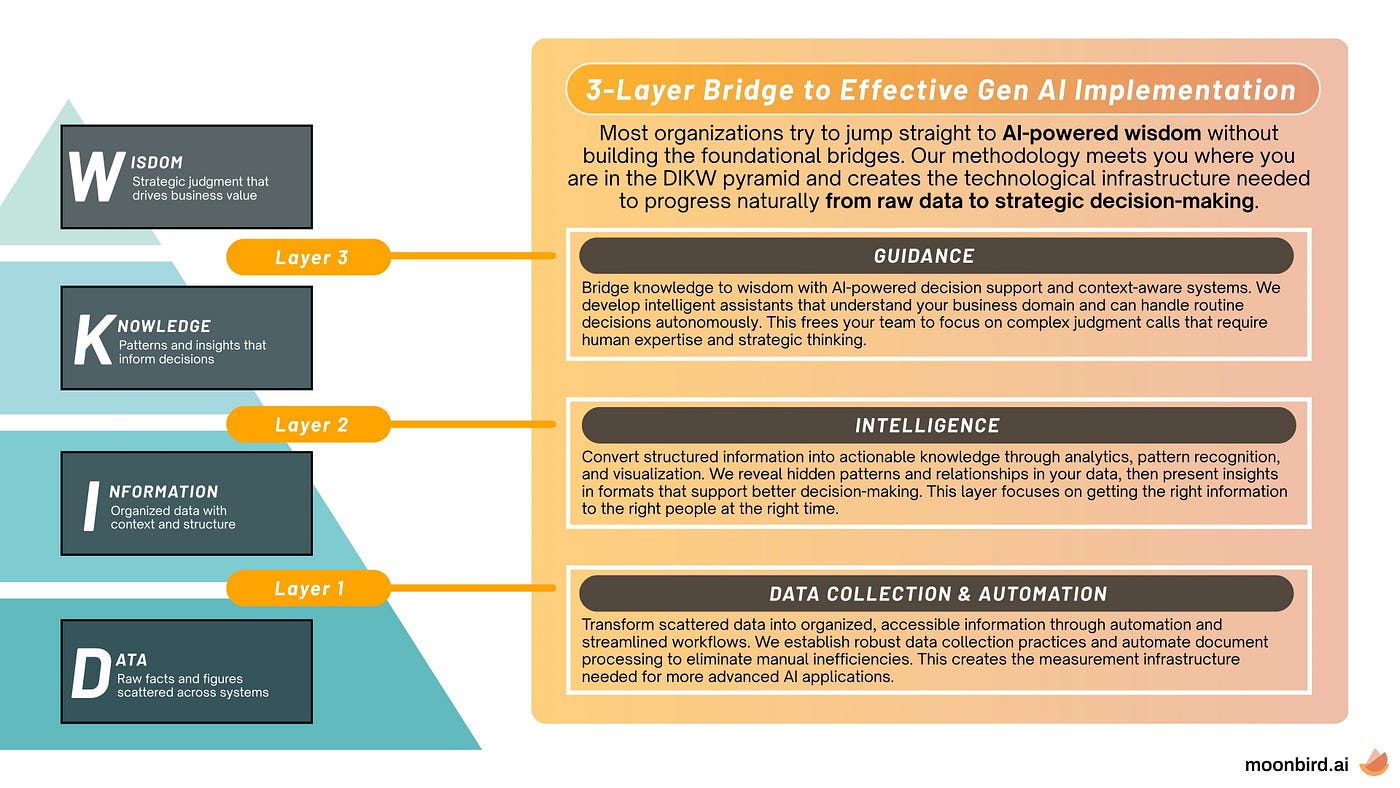
Layer 1: Data Collection & Automation
The foundation of any successful AI implementation starts with getting your data house in order. This layer focuses on transforming raw, scattered data into organized, accessible information.
In this layer, we focus on:
- Establishing robust data collection and management practices
- Automating document processing and data extraction
- Creating the measurement infrastructure needed for more advanced applications
As Jeff Winter notes in his analysis of DIKW, “Building a strong foundation for data collection and storage is critical for any digital transformation initiative. This involves investing in the right tools and technologies to ensure accurate and comprehensive data capture” (Winter, “DIKW Pyramid”), all of which is equally important for getting the most out of your generative AI implementations. I couldn’t have put it better.
Layer 2: Intelligence & Processing
Once your data foundation is solid, we move to intelligence — transforming information into knowledge by revealing patterns, relationships, and insights. This is about getting all data in the right place and format, then into the right hands so decision-makers can act on it.
This layer focuses on:
- Data visualization that makes complex information accessible
- Pattern recognition that identifies opportunities and risks
- Predictive analytics that forecast trends and outcomes
The power comes from what the DIKW framework describes as answering the “how” questions. According to Ontotext, “When we don’t just view information as a description of collected facts, but also understand how to apply it to achieve our goals, we turn it into knowledge. This knowledge is often the edge that enterprises have over their competitors” (Ontotext, “What Is the Data, Information, Knowledge, Wisdom Pyramid?”).
Layer 3: Guidance & Decision Support
The most advanced layer involves AI systems that can make or support decisions by replicating human expertise. This is where generative AI truly shines — not replacing human wisdom, but augmenting it.
At this layer, we develop:
- Workflow orchestration that connects previously siloed knowledge
- Knowledge management systems that capture and apply organizational expertise
- Autonomous systems that can handle routine decisions with human oversight
Here’s where our framework extends the traditional DIKW pyramid. While wisdom traditionally remains purely human, we see generative AI as a powerful augmentation tool — handling routine decisions (or at least making suggestions based on all of the data, information, and knowledge that can be provided) while freeing humans to focus on complex judgment calls that require uniquely human discretion.
Finding Your Starting Point: Starting with Understanding, Not Technology
Since every company’s processes, problems, and culture are completely different, before we dive into solutioning we spend time getting to know your business to figure out where exactly your opportunities lie.
During our Discovery Engagement, we invest a minimum of 50 hours getting to know your team, processes, and challenges. This is the foundation that determines everything that follows. We immerse ourselves in your industry, conduct stakeholder interviews, assess your technical infrastructure, and sometimes even develop functional prototypes to demonstrate potential solutions.
The beauty of this framework is its flexibility. Depending on your organization’s maturity, if you’re looking to implement generative AI our framework gives clarity on where you might start:
- Struggling with data quality or manual processes? We’d have you start with Layer 1. Generative AI might be able to help with this if you have unstructured datasets or data that needs to be standardized or processed.
- Have good data but aren’t extracting actionable insights? We’d have you focus on Layer 2. A lot of this is just good analyst work. Once you’ve got the data this is about getting it all displayed, combined, and aggregated in a helpful way.
- Have strong analytics but want to automate decision-making? We’d explore Layer 3. This is when generative AI will probably be the most help. If your decision making is more of a decision tree sort of thing you might not even need generative AI, but for the most part when replicating previously human-owned decision making tasks, generative AI is going to be your best friend.
Some parts of your organization might be ready for Layer 3 while others still need more foundational work. That’s perfectly normal! Luckily the steps build on each other, so strengthening your foundation naturally prepares you for more advanced applications.
Let’s Start with Understanding
If you’re considering implementing AI in your organization, we encourage you to think about where you sit on this pyramid. Do you have the data foundation? Are you extracting meaningful information? Is that information becoming actionable knowledge?